

Have you ever felt that saying “sorry” too often makes you sound unsure or unprofessional? Learning how to say sorry without saying sorry can help you communicate with confidence while still showing respect and accountability. In workplaces, customer service, and even relationships, using professional apology phrases and alternatives to saying sorry allows you to express regret in a stronger, more solution-focused way.
Instead of repeating apologies, you can rely on customer service empathy statements, workplace apology alternatives, and expressing empathy without apology to acknowledge issues and move forward positively. This approach not only shows emotional intelligence but also helps you maintain credibility, trust, and professionalism in every conversation.
⭐ Quick Answer (Featured Snippet)
To say sorry without saying sorry, acknowledge the issue, show empathy, take responsibility, and offer a solution. Use phrases like “I understand how frustrating this must be,” “I take full responsibility,” and “Here’s how I will fix it.” This approach shows professionalism and emotional intelligence without over-apologizing.
Why You Might Want to Say Sorry Without Saying “Sorry”
There are many real-life situations where apology without using sorry is more appropriate and effective.
In professional environments, saying sorry repeatedly can make you appear unsure of yourself. Instead, using professional apology phrases shows leadership, accountability in communication, and strong workplace communication skills.
In customer service, you may need to show empathy without admitting fault. This is where customer service empathy statements and positive customer service responses become powerful.
In relationships, sometimes actions speak louder than words. Expressing regret through behavior, empathy, and accountability often repairs trust faster than a simple apology.
When You Should NOT Avoid Saying Sorry

Let’s be clear: there are moments when a direct apology is necessary.
If you’ve hurt someone emotionally, made a serious mistake, or caused damage then saying “sorry” directly is the right thing to do. Avoiding it can look like you are escaping responsibility.
How to say sorry professionally matters when:
- You caused emotional harm
- You made a serious workplace error
- You broke trust in a relationship
- You damaged someone’s reputation
In these cases, a direct apology combined with accountability in communication is the best approach.
Powerful Alternatives to Saying “I’m Sorry”
Here are effective alternatives to saying sorry that communicate empathy, responsibility, and professionalism.
Accept Responsibility Without Saying Sorry
Instead of apologizing, take ownership:
- “I take full responsibility for this issue.”
- “This was an oversight on our side.”
- “I understand where things went wrong.”
These phrases show taking responsibility without guilt while maintaining professionalism.
Express Empathy Instead of Apologizing
Use empathy-driven communication:
- “I understand how inconvenient this must be.”
- “I can imagine this has been frustrating.”
- “I see why this would be confusing.”
This is a key part of emotional intelligence communication and professional empathy skills.
Show Appreciation Instead
Gratitude can be more powerful than apology:
- “I appreciate your patience and understanding.”
- “Thank you for bringing this to our attention.”
- “I value your feedback.”
This technique is widely used in corporate communication etiquette.
Focus on the Solution
Shift toward fixing the problem:
- “Here’s what I will do to fix it.”
- “Let’s make this right.”
- “I’ve already taken steps to correct this.”
This shows strong conflict resolution communication and forward thinking.
How to Apologize Without Saying Sorry (Step-by-Step Method)
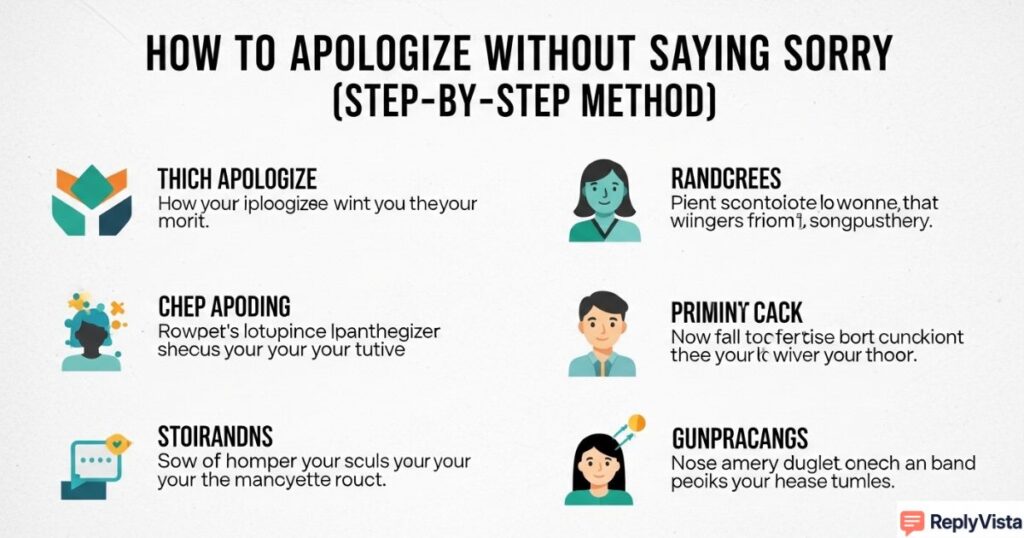
If you want to learn how to express regret professionally, follow this simple structure.
Step 1 – Acknowledge the Issue
Recognize the problem clearly.
Step 2 – Take Ownership
Say: “I take full responsibility for this issue.”
Step 3 – Show Empathy
Use non-apology empathy statements like:
“I understand how frustrating this must be.”
Step 4 – Offer a Solution
Say:
“Here’s how we will resolve this.”
This structure is commonly used in business apology examples and professional email apology structure.
Professional Ways to Say Sorry at Work Without Saying Sorry
At work, the goal is to show professional tone in emails and confidence.
If You Missed a Deadline
“Thank you for your patience. I’ve completed the task and ensured it meets the required standard.”
If You Sent the Wrong Email
“I noticed an error in the previous email. Here is the correct information.”
If You Were Late to a Meeting
“Thank you for waiting. I appreciate your time.”
If You Disagree With a Colleague
“I hear your perspective. Here’s how I see it.”
These are strong workplace apology alternatives that maintain authority.
Customer Service Examples (Without Saying Sorry)
In customer support, it’s important to use empathetic customer service language.
Empathetic Response Example
“I understand this is frustrating for you.”
Taking Ownership Without Apologizing
“This was an oversight on our side.”
Offering a Resolution
“I can help you fix this issue right away. Let me guide you through the solution.”
These are effective customer complaint response examples and are widely used in handling customer complaints professionally.
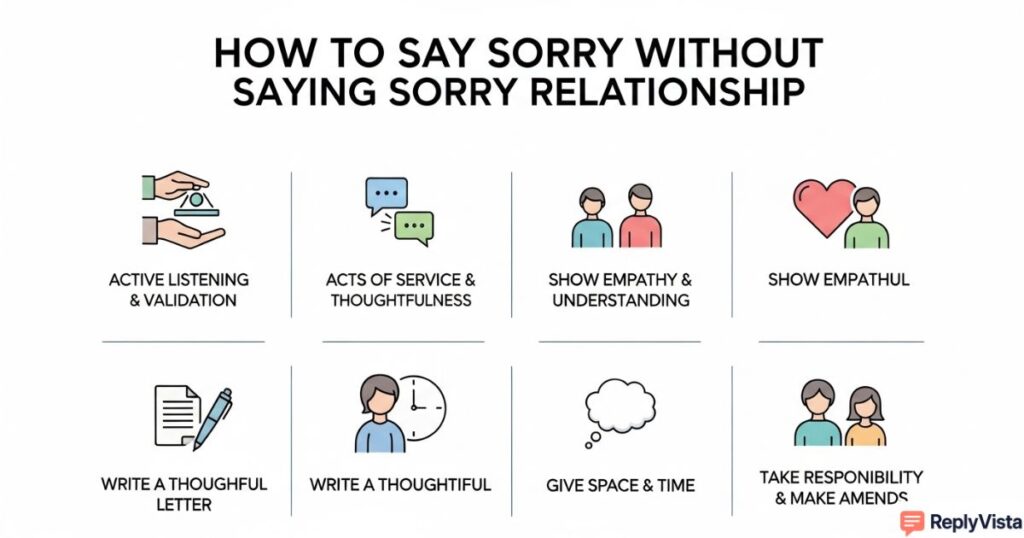
How to Say Sorry Without Saying Sorry in a Relationship
In relationships, relationship repair language and empathy matter more than the word “sorry.”
Show Empathy
“I know your time is valuable and I understand why this upset you.”
Take Responsibility
“I understand where I went wrong.”
Use Actions Instead of Words
Do something meaningful to fix the situation.
Communicate Intentions
“Moving forward we will ensure this doesn’t happen again.”
This approach builds trust and strengthens emotional connection.
Common Mistakes to Avoid When Not Saying Sorry
When using ways to apologize professionally, avoid these mistakes:
- Sounding arrogant
- Ignoring responsibility
- Using robotic corporate language
- Being passive-aggressive
The goal is expressing empathy without apology, not avoiding responsibility.
20 Phrases You Can Use Instead of “I’m Sorry”
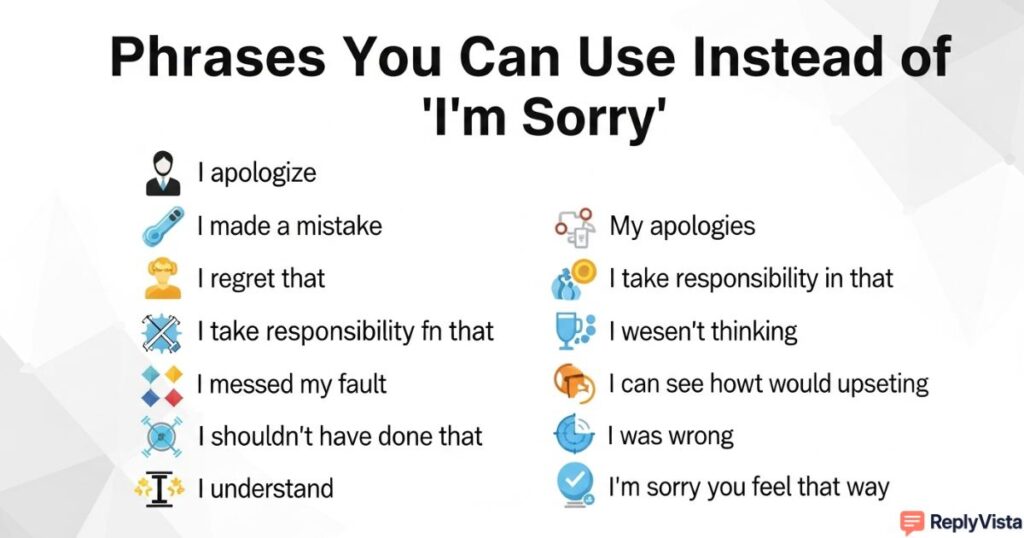
Here are some professional apology phrases you can use:
- I appreciate your patience
- Thank you for your understanding
- I understand your concern
- Let me fix this for you
- I take full responsibility for this
- This was an oversight on our side
- I understand how frustrating this must be
- Here’s what I will do to fix it
- I’ve already taken steps to correct this
- I will improve this process moving forward
- Let’s make this right
- Here’s what we can do next
- Moving forward we will ensure better results
- I hear your feedback
- Thank you for bringing this up
- I value your time
- I can help you with that
- I understand your expectations
- Let me resolve this quickly
- I will make sure this gets resolved quickly
Quick Comparison – Saying Sorry vs Not Saying Sorry
| Situation | Say Sorry | Avoid Saying Sorry |
|---|---|---|
| Minor delay | ❌ | ✅ |
| Big mistake | ✅ | ❌ |
| Customer complaint | ❌ | ✅ |
| Hurt feelings | ✅ | ❌ |
Recommended: How to Respond to WSG.
Expert Tips to Communicate Apologies Effectively
To master how to respond professionally without apologizing, remember:
- Your tone matters more than your words
- Show genuine empathy
- Take accountability clearly
- Focus on solutions
- Follow up with action
These are key principles of professional empathy skills and workplace communication skills.
FAQs – How to Say Sorry Without Saying Sorry
Is it rude not to say sorry?
No, as long as you show empathy and responsibility clearly.
Is saying thank you better than sorry?
In many professional situations, yes. Gratitude sounds more confident.
Can this work in customer service?
Yes. It is widely used in customer support communication phrases.
Does this work in relationships?
Yes, especially when combined with actions and empathy.
Final Thoughts
Learning how to say sorry without saying sorry is an essential skill in modern communication. Whether you are working in customer service, managing a team, or maintaining relationships, the ability to show empathy, take responsibility, and provide solutions without overusing the word “sorry” makes you sound more confident and emotionally intelligent.
Remember the formula:
👉 Empathy + Responsibility + Solution = Powerful Communication
Master this, and you will never struggle with apologies again.

We are an AI-powered SEO and content writing platform dedicated to helping websites rank higher, grow organic traffic, and look their best. Our mission is to make SEO and web design simple, effective, and accessible for everyone. Let’s achieve more together.