


Imagine walking through a charming street in Cardiff or chatting with a Welsh friend saying a simple “thank you” in Welsh can instantly make your interaction warmer. Knowing diolch yn fawr meaning (“thank you very much”) is just the beginning. Welsh is full of Welsh gratitude phrases that range from casual and playful to formal and heartfelt.
Choosing the right expression not only shows politeness but also conveys genuine appreciation. From informal Welsh thank you phrases for friends to formal Welsh thank you options for professional or ceremonial settings, this guide will help you confidently navigate Welsh expressions of gratitude, making your thanks memorable and sincere.
30 Unique Ways to Say Thank You in Welsh
Welsh is full of ways to express gratitude, ranging from casual phrases for friends to formal expressions for professional or ceremonial settings. Using the right phrase shows thoughtfulness, strengthens connections, and highlights your understanding of Welsh gratitude phrases. Below are 30 ways to say “thank you” in Welsh, complete with pronunciation tips and context:
Common Ways to Say ‘Thank You’ in Welsh
1. Diolch – “Thank you”
Pronunciation: Dee-olch
A simple, everyday phrase perfect for casual situations.
2. Diolch yn fawr – “Thank you very much”
Pronunciation: Dee-olch un vow-er
Use when you want to express deeper appreciation.
3. Diolch o galon – “Thanks from the heart”
Pronunciation: Dee-olch o gah-lon
Ideal for heartfelt gestures or meaningful favors.
4. Diolch yn fawr iawn – “Thank you very, very much”
Pronunciation: Dee-olch un vow-er ee-awn
For strong emphasis in exceptional situations.
5. Diolch am bopeth – “Thank you for everything”
Pronunciation: Dee-olch ahm bop-eth
Perfect for ongoing support or cumulative help.
Informal or Everyday Thank You Expressions
6. Ta – “Thanks”
Pronunciation: Tah
Short and casual, great for friends.
7. Diolch bach – “A little thank you”
Pronunciation: Dee-olch bah-ch
For small gestures or minor favors.
8. Diolch eto – “Thanks again”
Pronunciation: Dee-olch eh-to
Ideal for repeated favors.
9. Diolch yn llawn – “Thanks fully / completely”
Pronunciation: Dee-olch un hlawn
Adds emphasis in informal settings.
10. Diolch yn fawr iawn iawn – “Thanks very, very, very much”
Pronunciation: Dee-olch un vow-er ee-awn ee-awn
For playful exaggeration among friends.
Formal or Polished Ways to Say Thank You
11. Rwy’n ddiolchgar – “I am thankful”
Pronunciation: Roo-in thee-olch-gar
Use in speeches, emails, or formal settings.
12. Dros y byd, diolch – “Thank you beyond measure”
Pronunciation: Drohs uh bead, dee-olch
Poetic and ideal for heartfelt gestures.
13. Diolch yn ffurfiol – “A formal thank you”
Pronunciation: Dee-olch un fur-vee-ol
Professional or ceremonial use.
14. Fy niolch mwyaf – “My greatest thanks”
Pronunciation: Vuh nee-olch moo-eye-ahv
For profound gratitude.
15. Diolch o galon i ti – “Heartfelt thanks to you”
Pronunciation: Dee-olch o gah-lon ee tee
Friendly and warm for personal appreciation.
Fun, Unique, or Playful Thank You Phrases
16. Diolch diolch – “Thanks, thanks”
Pronunciation: Dee-olch dee-olch
Lighthearted and playful.
17. Llawer o ddiolch – “Lots of thanks”
Pronunciation: Hlah-wer o thee-olch
Adds enthusiasm to gratitude.
18. Diolch am eich amser – “Thank you for your time”
Pronunciation: Dee-olch ahm aych ahm-ser
Professional or formal acknowledgement.
19. Mae gen i ddiolch – “I have thanks”
Pronunciation: My gen ee thee-olch
Slightly poetic, expressive.
20. Diolch yn fendigedig – “Wonderful thanks”
Pronunciation: Dee-olch un ven-dee-geh-dig
For extraordinary favors or moments.
Casual & Friendly Ways to Say Thanks
21. Diolch mawr – “Big thanks”
Pronunciation: Dee-olch mawr
Simple, friendly, and casual.
22. Diolch fawr iawn – “Thanks a lot”
Pronunciation: Dee-olch fawr ee-awn
Great for friends and family.
23. Diolch yn fawr iawn i ti – “Thanks very much to you”
Pronunciation: Dee-olch un vow-er ee-awn ee tee
Adds a personal touch.
24. Diolch i bawb – “Thanks to everyone”
Pronunciation: Dee-olch ee powb
Perfect for group appreciation.
25. Diolch yn fawr iawn i chi – “Thanks very much to you (formal)”
Pronunciation: Dee-olch un vow-er ee-awn ee khee
Polite, for colleagues or elders.
Creative or Cultural Thank You Phrases
26. Diolch am bopeth wnaethoch chi – “Thank you for all you’ve done”
Pronunciation: Dee-olch ahm bop-eth wnaeth-och khee
Shows gratitude for effort or commitment.
27. Diolch gyda’r galon – “Thanks with the heart”
Pronunciation: Dee-olch gwith-a’r gah-lon
Expresses deep emotional thanks.
28. Diolch i ti o galon – “Heartfelt thanks to you”
Pronunciation: Dee-olch ee tee o gah-lon
Friendly and warm.
29. Diolch am bopeth i ti – “Thanks for everything (to you)”
Pronunciation: Dee-olch ahm bop-eth ee tee
Informal, personal, and appreciative.
30. Diolch yn fawr iawn iawn iawn – “Thanks very, very, very much”
Pronunciation: Dee-olch un vow-er ee-awn ee-awn ee-awn
Playful exaggeration for friends or family.
Recommended: Birthday Thank You Responses
Replying to “I’m Fine, Thanks” in Welsh
A simple, polite response to Welsh language greetings is:
“Iawn, diolch” – “Fine, thanks.”
Pronunciation: Ee-awn, dee-olch
This is a versatile reply for everyday interactions, from casual chats to formal conversations.
Four Ways to Answer “Diolch” (Thank You) in Welsh
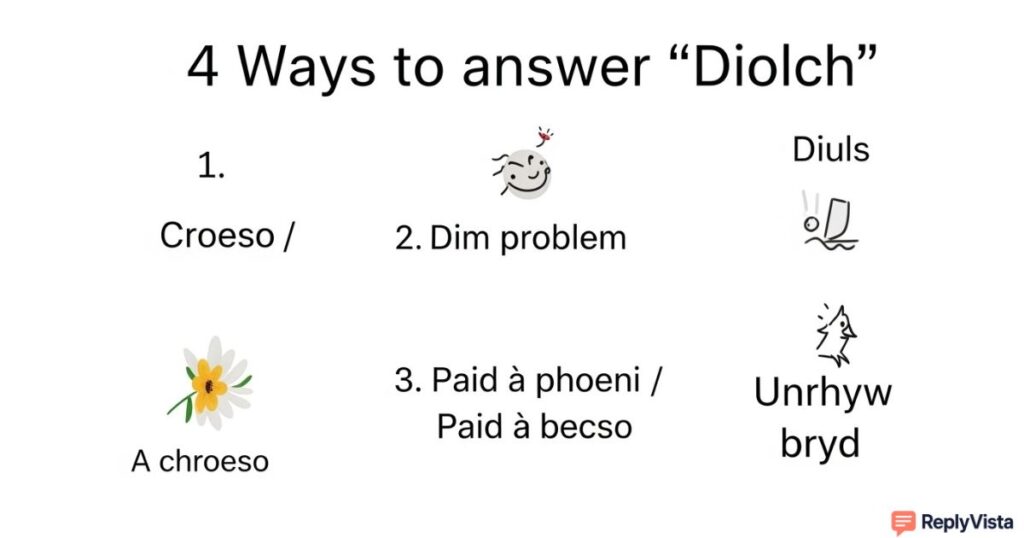
Knowing how to respond to someone saying diolch is just as important as saying thank you itself. The right response shows politeness, reinforces social bonds, and demonstrates your understanding of Welsh expressions of appreciation. Depending on the context formal, casual, playful, or friendly you can choose from a variety of responses. Here are four practical ways:
1. Croeso / A chroeso
“You’re welcome.”
Pronunciation: Kroy-so / Ah khroy-so
This is the most common and standard reply in Welsh. Use it in everyday situations, from a shop assistant thanking you to a friend expressing appreciation for a small favor. It’s polite, concise, and universally understood. For example:
- Friend: Diolch am helpu gyda’r gwaith cartref!
- You: Croeso!
This conveys warmth while keeping the interaction simple and respectful.
2. Dim problem
“No problem.”
Pronunciation: Deem proh-blem
Perfect for casual and friendly interactions, dim problem signals that helping was effortless and you’re happy to assist. It’s ideal for situations like giving someone directions, lending a small item, or helping with minor tasks. Using this phrase keeps the conversation light and approachable. Example:
- Colleague: Diolch am fy helpu gyda’r adroddiad!
- You: Dim problem!
It subtly communicates confidence, composure, and kindness.
3. Paid â phoeni / Paid â becso
“Don’t worry about it.”
Pronunciation: Pide ah phoy-nee / Pide ah bek-so
This slightly playful and reassuring response is perfect when you want to add charm to your gratitude exchanges. Use it with friends, family, or close colleagues after small favors or lighthearted help. It conveys that the task was no trouble at all and can make the other person smile. For instance:
- Friend: Diolch am fy helpu gyda’r plant!
- You: Paid â phoeni!
It’s also a culturally friendly way to show that you value effort without making it formal or stiff.
4. Unrhyw bryd
“Anytime.”
Pronunciation: Unr-hweee breed
This response is casual, flexible, and very approachable. It communicates that you’re happy to help again in the future, creating a sense of ongoing support. Use this phrase when the favor was a bit bigger, like helping a friend move or providing guidance. Example:
- Friend: Diolch am y llyfr, roedd yn ddefnyddiol iawn!
- You: Unrhyw bryd!
It’s perfect for reinforcing Welsh casual thank you replies and makes your response feel genuine and inviting.
Pro Tips for Responding in Welsh:
- Match your response to the tone of the interaction formal or casual.
- Pronounce the words clearly, especially with friends or non-native speakers, so they appreciate the effort.
- Combine responses with a smile or nod to enhance sincerity.
- For playful interactions, Paid â phoeni adds personality and warmth, making your gratitude exchange memorable.
By mastering these four replies, you not only sound polite but also show emotional intelligence, cultural awareness, and fluency in Welsh expressions of appreciation.
How to Pronounce Diolch yn Fawr Iawn
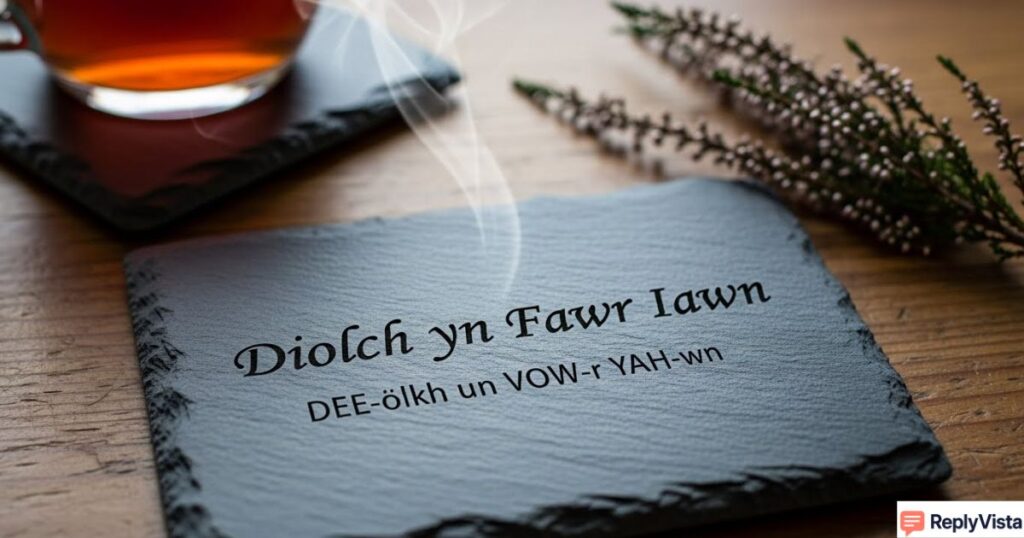
Pronouncing Welsh phrases correctly ensures your gratitude feels authentic and respectful. Diolch yn fawr iawn is a strong and emphatic way to say “thank you very much,” and proper pronunciation enhances its impact.
diolch yn fawr iawn correctly
Pronunciation: Dee-olch un vow-er ee-awn
Break it into syllables for clarity, and remember that “fawr iawn” adds emphasis beyond the simple diolch. Use it in situations where someone has gone above and beyond—like organizing an event for you or helping with something important. Example:
- Teacher: Diolch am helpu gyda’r cynllun ysgol!
- You: Diolch yn fawr iawn!
It’s formal enough for teachers or supervisors but friendly enough for friends.
When to choose diolch vs diolch yn fawr
Use diolch for everyday casual thanks, like small favors or minor gestures. Diolch yn fawr conveys deeper gratitude, suitable for gifts, favors, or meaningful assistance. Understanding this distinction avoids overusing formal phrases in casual contexts and ensures your Welsh gratitude phrases sound natural.
How to give a formal Welsh thank you
For formal situations, such as professional meetings or ceremonial events, phrases like Rwy’n ddiolchgar or Diolch yn ffurfiol are ideal. Pairing these with a polite tone, eye contact, or written notes enhances respect and professionalism. Example:
- Email to a mentor: Rwy’n ddiolchgar am eich canllaw a’ch cefnogaeth. (“I am thankful for your guidance and support.”)
Meaning of o galon in thank you expressions
The phrase Diolch o galon literally means “from the heart” and communicates sincerity and emotional depth. Use it when you want to express heartfelt thanks in Welsh to friends, family, or someone who has made a significant impact in your life. Example:
- Friend: Diolch am bopeth!
- You: Diolch o galon!
It’s poetic, genuine, and perfect for occasions where simple thanks might feel insufficient.
Typical replies to diolch yn fawr
Common responses include:
- Croeso – standard “you’re welcome”
- Dim problem – casual, friendly
- Iawn, dim o gwbl – polite, warm
- Unrhyw bryd – “anytime,” flexible and approachable
Choosing the right response depends on the relationship, setting, and tone. Combining proper pronunciation with appropriate phrases ensures your gratitude exchanges are meaningful, culturally aware, and memorable.
Final Thoughts
Welsh offers a rich variety of gratitude expressions, from casual ta to formal Diolch yn ffurfiol. Understanding diolch yn fawr meaning and knowing when to use each phrase enhances communication, strengthens cultural awareness, and ensures your gratitude is genuine. The next time someone does something kind, choose a phrase casual, formal, playful, or heartfelt that reflects the moment. Mastering these expressions makes your thanks memorable, meaningful, and truly felt.
FAQs About “Diolch yn Fawr”
1. How do you pronounce Diolch yn fawr?
Pronounced: Dee-olch un vow-er. Break it into syllables and say slowly at first. It’s a polite and proper way to express thanks in Welsh.
2. What does Diolch yn fawr mean in Welsh?
It means “thank you very much”. Use it when you want to show sincere or strong appreciation.
3. What is the slang meaning of Diolch yn fawr?
In casual slang, it can simply mean “thanks a lot” among friends or in informal situations.
4. What does Diolch yn fawr mean in English?
Directly translated, it is “thank you very much”, showing more gratitude than the basic diolch.
5.How should I respond to Diolch yn fawr?
Common replies include: Croeso (“you’re welcome”), Dim problem (“no problem”), or Iawn, dim o gwbl (“fine, no problem at all”).

We are an AI-powered SEO and content writing platform dedicated to helping websites rank higher, grow organic traffic, and look their best. Our mission is to make SEO and web design simple, effective, and accessible for everyone. Let’s achieve more together.